Time Vs. Distance – What’s the difference???

I am often asked, why do you prefer to run by time and or coach your athletes to train based on time vs. distance? What is the difference?

First, I’ll give you a little background as to WHY I prefer time. Long before the almighty Garmin GPS watch came about, runners and distance athletes had something prehistoric, called a WATCH!! What could this watch do?? Well, it could tell time and that was about it! If you had a fancy one, like a Timex Ironman, it would also record laps (which was sooooo cool!!).

Now days, we have the Garmins (among other brands) that will record distance, heart rate, calories burned, pace, elevation, etc, etc. These things are amazing training tools and can be awesome components to a good training plan…however, they can also be your own worst enemy. They suck you in with that exact distance, exact pace! Heaven forbid you only run 7.93 instead of an exact 8 miles…just imagine how horrible your next race would be if you didn’t have exact distances for each of your training runs (I am being sarcastic, of course!).

So, WHY do I prefer to use time more so than distance?

PROGRESSION TRACKING – Too often with runners, we want to pile on more mileage than our bodies are currently ready to handle, only to wind up injured, over fatigued, or both. So, how can time vs. distance make a difference? Lets take a “cookie cutter” training plan for the marathon. In this plan, lets say that you are to run 6 miles per day, everyday for 7 days (totaling 42 weekly miles).

Now, aside from the amount of miles you have to run, you also have to account for the amount of time it will take. So, lets say two runners of the sport, both running the same plan, but both of varying abilities. So we have Runner A and Runner B.

Runner A is able to cover her 42 miles per week at an average of 8 minutes per mile pace, which gives a grand total of 5 hours and 36 minutes running time for the week.

Runner B is able to cover his 42 miles per week at an average of 10 minutes per mile pace, which gives a grand total of 7 hours running time for the week.

As you can see, Runner B is on their feet for 1 hour and 24 minutes longer per week than Runner A. That is a substantial amount of time more to be out there on your feet running.

Running by time also allows the body to adapt and progress at the rate in which it is absorbing the training workload. For instance, a typical training plan might call for a 5 mile tempo every Thursday, adding 1 mile to your tempo every few weeks. But, how do you know your body is ready to make a complete mile jump in distance?

If you run by time, you can start your Thursday tempo at 40 minutes. Lets say your run an 8 minute pace. You will be covering 5 miles during this amount of time running. As the weeks go by and as your body adapts and progresses, now that 40 minute run may produce 5.25 miles, a few weeks later 5.6 miles and so on and so on. As you start maximizing the distance that you can obtain in that 40 minute window, then, instead of adding another mile, you just add another 5 minutes or so, with training paces remaining constant and only progressing or getting faster as your fitness improves.

This is particularly important for the longer runs that you need if you are training for a marathon. Somewhere, years ago, Americans became obsessed with the magical 20 miler, with many training plans calling for 22, 24 and even up to 28 miles for marathon training.

The argument is always “Just need to get time on your feet”. Which, is partially true. But, again this all comes back to skill level and current fitness and training levels. It is pretty well observed and researched that the “long run” shouldn’t be anymore than 25-30% of your weekly mileage total. However, most runners are doing 40%, 50% and sometimes even more than that in just one single long run. Here is another example of two different runners with two different marathon goals.

Runner A – Goal marathon = 3:10, Weekly mileage = 60. For this runner, the weekly long run would be in the 15-18 mile range, based on the 25-30% rule. If this runner were to do an 18 mile long run at 7:45 pace, they would finish in 2 hours and 20 minutes.

Runner B – Goal marathon = 5:00, Weekly mileage = 36. For this runner, the weekly long run would be in the 8-12 mile range, based on the 25-30% rule. If this runner were to do an 18 miler, as most training plans might call for, at 10:00 pace, not only would it account for 50% of their weekly mileage, it would also take them 3 hours to complete.

So, why do two different runners, with two completely different weekly mileage and different time goals, often run the exact same distance for their long runs? I blame peer pressure and these “cookie cutter” training plans. In my own training group, I will see the same distances being covered weekly by nearly all the various skill levels of runners that are out there. One runner may be a 2:50 marathoner running 80 miles per week and one may be a 4:50 marathoner running 40 miles per week, yet, they are both doing a 20 mile long run…Doesn’t make much sense, does it?

From a physiological standpoint, the body doesn’t understand or know distance. However, the body does understand frequency, duration and intensity.

If two runners are running at the same relative intensity for the same duration, it can be assumed that they got the exact same benefits and the same type of workout, regardless of the respective distances that they each covered.

Most training schedules and plans are often based off of a plan that was designed for an elite runner, then was modified a bit and or diluted a bit to accommodate the “Average Joe Marathoner”.

The body tends to expend its glycogen stores around the 2 hour to 2 1/2 range and nearly any and all physiological benefits of the long run are absorbed during this time. No evidence has been shown to suggest that running longer is anymore beneficial.

So, if the body is using up all of its glycogen stores (or at least most of it) during a 2-2:30 long run, what does that mean? On average, it takes 48-72 hours to replenish drained glycogen stores (provided you are refueling with the right foods, fluids). So, if you go out and your 3 hour long run and severely deplete your glycogen stores, you likely won’t have them replenished again until the following Tuesday and that is only assuming you did no other running or excercise to deplete them further. This is why the body and legs are often rather tired and fatigued after hard training runs, rides, swims, etc. If you deplete your glycogen and then only replenish 70% of it to the muscles, then go hard again, you are already working with a deficit.

An elite level marathoner could do a typical 18 mile run at 6:00 pace, giving him/her a total run time of 1 hour 48 minutes, thus, never having gotten to the point of glycogen depletion. So, as you can see, an 18 mile run for one runner becomes a totally different workout than what it would be for another runner.

As always, every individual is different and can handle different stresses and different workloads. But, if you seek the best out of your training and your body, you should probably consider taking care of it.

There is a very important adaptation process that the body has to go through in order to improve and progress. The idea is to stress the body, just enough to signal a adaptation response, but not so much as to over stress it to extreme fatigue or injury.

The body needs time to recover and regenerate in order to improve and be able to respond to the next bout of high intensity training. Each training activity should have a specific purpose and each run should focus on a specific area.

If you want to become a good marathoner, you need to start getting the body adapted and ready to handle the paces and the stresses of the marathon….essentially, you want to maximize gains with the least amount of expenditure.

Often times, during a marathon, a runner will become dehydrated. It is something that you should try to avoid, but it is a likely scenario…so, with that said, why doesn’t marathon coaches recommend during all their long runs from a dehydrated level?

Because it would be absolutely absurd and would be putting the runner at extreme risks! The same level of caution should be taken for other faucets of training. Just because you CAN run a certain distance or intensity every day, it doesn’t mean that it is wise, nor does it mean that you will see any improvement..in fact, you will likely break down over time and will see diminishing returns from your efforts.

GROUP RUNNING – Another reason running by time works well is that it is the same, no matter who is using it. If you run with a group, like I do, you run with runners of varying skill level. So, if you all meet up for a Tuesday night 8 mile run, then there will be time ranges of less than an hour, to maybe an 1 hour and 30 minutes. However, if you all start out with the intent to run 1 hour, no matter what the pace or distance covered, everyone gets the same workout, relative to their abilities. One runner may cover 7 miles in an hour, while one runner covers only 5 miles in the hour, yet, the level of effort and the benefits of the run will be the same for each runner (provided they are working at similar intensities).

PSYCHOLOGICAL- Lets say set you set out to run 1 hour. So, you head out and run for 30 minutes, then turn around and run back to your starting point, only to find that your total run time was 59:28. What does that mean? That means you “negative split” your run and that you ran your second half faster than your first. Just this slight pickup in pace, might be all you need to see progression and improvement. As you continue seeing greater distances ran, within the same time window, it will likely be a great boost of confidence. Remember, little goals piled high, will help you climb to your big goal!

So, maybe you aren’t ready to give up your sacred “exact distance” mindset..but, just try doing a “timed” run once a week and see how you like it. Find new ways to change up that 30, 45, 60 minute run. Perhaps use that one timed run each week to do a fartlek, mix and match, pickups, etc.

Keep your training fun and keep the body guessing and welcoming to change. Have fun and enjoy what you are doing…training should be fun, not stressful and work like.

HAPPY TRAINING!!!

2012: A Year in Review

Damn, where do I even begin? Well, since I am recapping a year, I suppose I begin at the start.

But, before I do a recap of the entire year, I will skip to August, before back tracking to January. Though the rest of the year was awesome, August takes precedence over all the other months. It was August that I married my long time girlfriend/fiancé, Crystle Santos (now Welch). We had a beautiful wedding in her hometown of Newport, Rhode Island. Many of our closest friends and family were there and it was by far the most amazing day of my life.
Through it all, ups and downs, she has stood by me and continues to stand by me. None of the rest of 2012 (or any other of our years’) would have been nearly as special, without her. She is my biggest fan, biggest critic and biggest supporter. She keeps me grounded and level.

W2

So, now that the biggest highlight of the year has been discussed, I will now take you through a rundown of some of the other awesome moments of 2012 (WARNING: IT’S ALL RUNNING STUFF!!!)

JANUARY- The turn of the year was looking very promising. I was getting into amazing running shape and was starting to really up the training mileage in preparation for my upcoming marathons. For my Boston marathon charity run with Team Hoyt, I even had a few people who were going to donate 1 dollar for every mile I ran in the month of January. With that as incentive, it was going to be a big month..THEN, midway through the month, I suffer a serious Achilles injury!! I was devastated. When it first happened, all I could think about was “No way can I run Shamrock in March and qualify for Boston”. I had to figure something out quick, I was running out of time!!

FEBURARY – For half of January and all of Feburary, my training mileage took a huge hit. I was only able to run 10 miles per week during this time. But, instead of giving up and calling it a wash, I refocused in order to maintain fitness and concentrate on getting to the starting line of Shamrock. I wasn’t running much, but I started aqua jogging about 10 miles per week and added about 30-50 additional miles rollerblading. I may have been down, but I wasn’t out!!

MARCH – The time had come!! Although I had been selected as a member of the Team Hoyt 2012 Boston marathon charity team, the BAA decided that in order to officially be allowed entry into Boston, pushing or not, I would have to qualify just like everyone else. This meant, that I would have to run a 3 hours 10 minute marathon or faster in order to qualify and solidify my spot on the team.

With very limited running mileage for the previous two months, I was quite nervous on whether or not I would be able to pull off such a feat. My previous PR for the marathon was 3:10, and that was running solo, not pushing a chair and rider. But, I was willing to do whatever it took at this point. Too many people were counting on me and there wasn’t a chance I was going to let them down.

So, with the 3:10 looming over our heads, Tim Brown (my rider athlete) and I set out with only one goal in mind…3:10 or bust!!

I will spare you the play by play of the marathon itself….but, long story short, we ran 3:09:39!! Nothing like making it a “barn burner”!!

Also would like to a give a big shout out to my long time friend (brother, more like it) William “Micky” Tallent..he ran an exceptional race and a huge PR with a 2:55!!

Shamrock

APRIL – Having qualified for Boston and needing some recovery and rest time, I spent the last two weeks of March and the first two weeks of April, running only once or twice per week. The rest of the time, I was living in the pool, aqua jogging and swimming to maintain my fitness before tackling Boston.

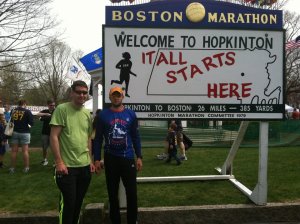
Boston Marathon in and of itself is the biggest rock show on earth (for runners)…From the moment we pulled into town, it was a non-stop, running inspired utopia. Everywhere we went, there was something cool to be seen. Essentially, we (Thomas Hicks and myself) were in running geek heaven!! Two nights before the race, Team Hoyt had their annual charity dinner and “meet and greet”. Tim and I got to meet and chat with the greats, Bill Rodgers and Uta Pippig (even got photos to prove it).

Hopkinton

The race itself, ended up being one of the hottest on record. By late morning, it was in the low 90’s and majority of the 26.2 miles was a complete suffer fest. Not willing to face the heat and conditions, nearly 4000 runners deferred their entry until 2013. But, for Tim, Thomas and myself, we came here to run Boston…no chance in hell we weren’t running it.

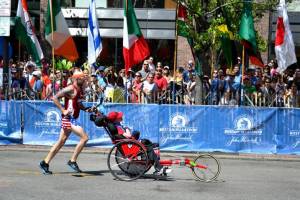
Tim and I started the race with legends, Dick and Rick Hoyt and were treated like rock stars throughout the entire run. The fan support was amazing and if not for them, the conditions would have been amplified. The crowd was passing out cold towels, ice, popsicles, lemonade, etc.

Boston2012#2

Ole Thomas Hicks had a hell of an experience as well…while conquering 26.2 miles the only way he knows how (on guts and heart), he had a bit of divine intervention…At one point, he encountered another charity team that were pushing for the MS Society (as you all know, Thomas suffers from MS). He shared a few miles with them and listened to their testimony and shared his. Then, later in the race, he runs with a man who lost his father to a lung tumor (Thomas too has a lung tumor)..needless to say, these two men inspired each other. Finally, Thomas runs into (no pun intended), the legendary, Dean Karnazes (Ultra runner machine). For several miles, they swapped stories…during this time, Dean was inspired and moved by Thomas’s testimony…Dean called Thomas, his hero!!

MAY – After Boston, there was some much needed recovery time to be had. So, for the second half of April and all of May, I continued rehab on my Achilles and minimized the time spent running. Spent the majority of the time, swimming, biking and rollerblading.

JUNE- After finally starting to recover from the Achilles injury, Thomas Hicks decided he would talk me into running the USATF Masters races with him. Though I hadn’t ran on the track competitively in over 10 years, I knew it would be a blast and because it was something Thomas had his heart set on, I decided, I was in!

In early June, there was the USATF Virginia Association Championships, in Richmond. Thomas, Rob Hunter and myself drove up to Richmond like a bunch of giddy school girls (yes, we were excited to be on the track again…once a miler, always a miler!). Though we didn’t have any real expectations, nor did we have a clue about where we would be for our mid-distance running, we all did rather well, running modern day PR’s, placing in and or winning our respective races and having a ton of fun!! In the 1500m, Thomas became the state record holder for Over 40 Masters!!

pre1500

In late June, the three of us drove up to Maryland for the USATF Mid-Atlantic championships. There, we again did very well and either won or placed in our respective age groups and races. Also, it is safe to say, the Masters scene in the area, now know who HRR is!!

JULY – No serious racing or running, just good training and fun with the running group and my training partners.

AUGUST – The best month of all!! As mentioned earlier, this is the month that Crystle and I got married. After nearly 6 years of being together, we finally took our vows and became husband and wife!

WeddingDay3

SEPTEMBER – This month was special because of the Colonial 200 Relay. A huge showing of HRR and fellow 757 runners decided to take part in the 200 mile relay, from Charlottsville to Jamestown. Aside from our crazy 10 person team, HRR had another team in the race, as did our Final Kick friends and another team consisting of many of our good running friends from the area. My team, Team Procrastinators and a Diva came in 2nd overall to Team 5 Dudes and Two Boobs (our friends Dai Roberts, Tommy Neeson, Ryan Carroll, Drew Midland, Joel Bell and Renee High).

DSC_0933

The relay was a ton of fun, lots of laughs and a few scary moments. Overall though, it was one amazing experience and something we plan to do again in 2013.

OCTOBER – This month was a big month for running. In the early part of the month, I paced my wife at the Crawlin Crab Half Marathon in Hampton. She ran an exceptional race and PR’d by over 15 minutes.

Crawlin Crab

At the end of the month, Chandler “BEAN” Doebler and I ran the Marine Corp Marathon in Washington D.C.
We ran together for Team Hoyt and had an amazing time. This was Chandler’s first marathon ever and he loved every mile of it. This was also a first time marathon for fellow Team Hoyters, Jenny Dugan and Jose Nogueras. The crowd support and the aura that is Marine Corp Marathon, was amazing!! Certainly a race I plan to do again.

October also produced many great races for many of my running friends and training partners. A few note worthy performances go to Justin Turner (2:31 and PR at MCM), Kris Lawrence www.kris-lawrence.com (2:50 and PR at Twin Cities) and Renee High (2:47 at Colombus) http://reneehigh.com/

NOVEMBER – This was an overall great training month, with a couple great races. In early November, I ran the Freedom Half marathon with Team Hoyt (managed to run a new PR as well)

At the end of the month, I ran the Turkey Trot 10k (another “modern era” PR).
Both of these races were a lot of fun and both produced many PR’s for my fellow HRR members and other running friends/training partners.

TurkeyTrot2

The rest of November was filled with several big races and PR’s for so many in the local running community. The Richmond marathon and OBX marathon, both produced lots of awesome race PR’s, were first time marathons for many and were overall great races for all!

DECEMBER – This month was a wonderful month all around. For the first time, I ran and completed a 50k race. This year, I ran the Seashore 50k. For the past two years, I paced a few friends and took part in some of the race, but I never finished it and I never set out to race it. This year, I decided I would go out and race it and see what I could do. I ended up doing quite well, 4th overall and I managed to PR my marathon in route to the finish. I had a great experience for my first official “Ultra” and I intend to do another one in the near future.

dennis27

The rest of the month was filled with the holiday spirit and family time. Crystle and I traveled to Rhode Island this year for the holidays and spent time with her family and friends.

So, to say the least, 2012 was an amazing year, filled with lots of great moments. Crystle and I made many new friends and shared many wonderful experiences together this year. Our running group http://www.meetup.com/HamptonRoadsRunners/ continues to provide us with wonderful people and wonderful times.
As you all reflect on the good and bad of 2012, remember that life is always changing, always moving forward and is always an experience to enjoy. Life is not a given and you are not guaranteed to wake up tomorrow. So, no matter what your goals or what your ambitions are for 2013, remember that family and friends are of the utmost importance, don’t neglect either of them. Have fun, enjoy what you do, but always keep things in perspective. If at all possible, make amends with your enemies, love your neighbor, show compassion and open your mind to all the possibilities that are out there….it’s a big world out there…enjoy it!
LIVE, LAUGH, RUN!!

Seashore 50k!

Dennis1

So, this race was my first OFFICIAL ultra-marathon…for the past two years, I ran half of the race pacing a friend or two. In 2011, I helped pace Kris Lawrence. In 2010, I helped pace Thomas Hicks. But this year, I decided I would throw my hat in the ring and actually try to race it.

I didn’t necessarily have any huge expectations for this race, but I did set a few small goals that I had hoped to acheive. 1.) Finish under 4 hours. 2.) Run a smart and conservative race for the first half, then open it up the second. 3.) Get my nutrtition on point and not crash and or lose significant energy over the second half of the race. 4.) Keep my heart rate in a conservative zone and do as little damage to my body as possible.

From the start, I had no intentions to “race” anybody. This year, there was a tough and competive crowd. Billy Edwards (last year’s winner) was back and looking to claim his title, Drew Midland was there (though he was only pacing), the always impressive and consistent, Steve Speirs was back and ready for business as usual. There was also an impressive ladies field, a few of my fellow HRR teammates and also a few first timers who were going to put up a great race.

dennisandrenee4

So…with a very competitive top 10 in the field, I decided to run MY race and not get caught up in the hoopla. I made it a point to let the front crowd go out at their quick paces and let the race unfold however it may. My plan was to stay conservative for at least the first half of the race, not get passed by any other racers, and hopefully, with any luck, pass a few of the other runners along the way.

For the first 3 miles, I was running along with 3 of my good friends/training partners, Thomas Hicks, William Tallent and Renee High…we were pretty much doing our normal “long run” routine of laughing and having fun. Renee wasn’t racing and was out getting in her long run, so she decided to keep me company for the early miles of the race.

There wasn’t really any pace strategy for the race..but, I did want to negative split the race if at all possible (meaning, I wanted the second half to be faster than the first). After going conservative for the first half of the race, I came off the first loop of Osmanthus with an average pace of 7:16. At this point, I was still feeling awesome and was feeling really strong, but, 16 more miles is still a loooooong way to go and anything can happen.

dennis13

Throughout the race (every 30 minutes), I would take my race fuel and hydration. For this race, I chose to go solely with my liquid (homemade) energy drink (combined with two scoops of UCAN) and my supplements. Every 45 minutes, it was a capsule each of calcium/magnessium/potassium/taurine/beta alinine/arginine/rhodiola… I took no gels for the race. I did however grab a handfull of Skittles at the 2nd to last aid station…I had ran out of my energy drink and I wanted to have a bit of sugar in case I needed it. I took the entire handfull of Skittles and put them in my mouth and sucked on them for the final 8 miles…if you suck them and don’t chew them, they will last for a long time and will dissolve slowly to give you a steady “drip” of sugar.

Another pre-race plan I had, was to keep my heart rate below 160 for as long as possible. My typical training paces for a moderate 60%-80% effort will reflect a heart rate zone of 130-158. For this race, my heart rate stayed in the mid 150’s the entire race, until the last mile, where I was pushing the pace a bit. Average heart rate for the entire run was 154…this was my most prized accomplishment for this race!!

At mile 17, I decided to see if I could start picking up the pace and start picking a few runners off. I passed a couple runners between mile 17.5 and mile 18.5. At about mile 19, I was creeping up on a pack of 5, that included Steve Speirs, Drew Midland, Steph Manny, Howie Hodapp and another runner (Ed). I ran for awhile with Drew and Steph, with Steve and Ed staying a consistent 40 meters ahead.

All the way down the narrows, I watched Steve and Ed slightly in front of me…at the turn around, Steve and I shared a few words of encouragement and at that point, he decided to make a move and make it a race. My pace never slowed from that point on, yet, Steve kept getting further away…there was a decision to be made at this point. Do I try to stay right behind Steve and his now mid 6:00 tempo, or do I continue to stay in my steady zone and let him go? The decision was to let him go. Steve has much more long distance race experience than I and he is a tough bastard as well. If it were the final mile, I would have been confident in my speed..but with 8 miles to go, Steve had the advantage and I knew that. I did not want to go completely in the well for this race and I knew that going with Steve would have put me there…over the next 8 miles, he put about 3 1/2 minutes time on me…but considering I never slowed my pace, I can live with that..Live to fight another day.

dennis18

At this point in the race, I was sitting in 5th place. I knew catching Billy Edwards was out of the question and the way that Steve took off, chances were not good that I would catch him again, either. So, I was hoping that maybe the other two guys in front of me, might be struggling and perhaps I could pick one or both of them off. With a mile to go, I got my wish! I saw the previously ranked 3rd place guy up ahead of me as we were nearing the end of the dreaded Osmanthus trail. It was obvious that Steve had overtaken this guy and was comfortably on his way to at least a 3rd place finish. As I trailed the guy for a half mile, I knew he was hurting…I decided to stay right behind him until we got off of Osmanthus…this would be exactly a half mile from the finish line and I knew I could out kick him and use my speed to my advantage. As soon as we came off the side trail and hit Cape Henry, I sprinted past him and kicked toward the finish. I ran the last half mile at a sub 6:20 pace, finished in 3:43:57..good enough for 4th place overall..behind some damn good runners!!

To be honest, I couldn’t have been more satisfied with the way this race turned out. For awhile now, I have been curious of how good my fitness actually was. I had been putting in some great training runs, but had not really raced all year. For the entire year, I have been putting a “non-typical” distance running schedule together. For 11 months, I have averaged only 32 miles per week and have only had a handful of weeks total for the year that have been over 40 miles.

All year, instead of focusing on mileage, mileage, mileage…I decided to go with a different approach. I focused on quality running, lots of xtraining (swimming, aqua running, weights, core and balance excercises). I also put a lot of emphasis on nutrition, recovery and perfecting the best race fueling and hydration practices.

This was the longest distance race I have ever ran and I can honestly say, it was hands down, the EASIEST!! I never crashed, bonked or hit the wall. I felt stronger and stronger as the race went on. I negative split the race by a significant amount and I was able to throw down my fastest mile of the race in the last mile.

dennis8

This was my “BOOYAH” race! I am not one to boast or brag..but this race was for all those naysayers..all those who said that my “low mileage” plan was silly and that it wouldn’t work for the long distance races…Well, I guess perhaps they were wrong.

It is also worth mentioning that I woke up this morning without a sore muscle in my body…I felt great today and spent the entire day on my feet, with my wife, walking around doing Xmas shopping.

I did the research, I made myself a guinea pig, I stuck to the plan despite all the negativity that I heard…. and finally, “the proof is in the pudding”!

Going to Runner Heaven!! R.I.P.

photo

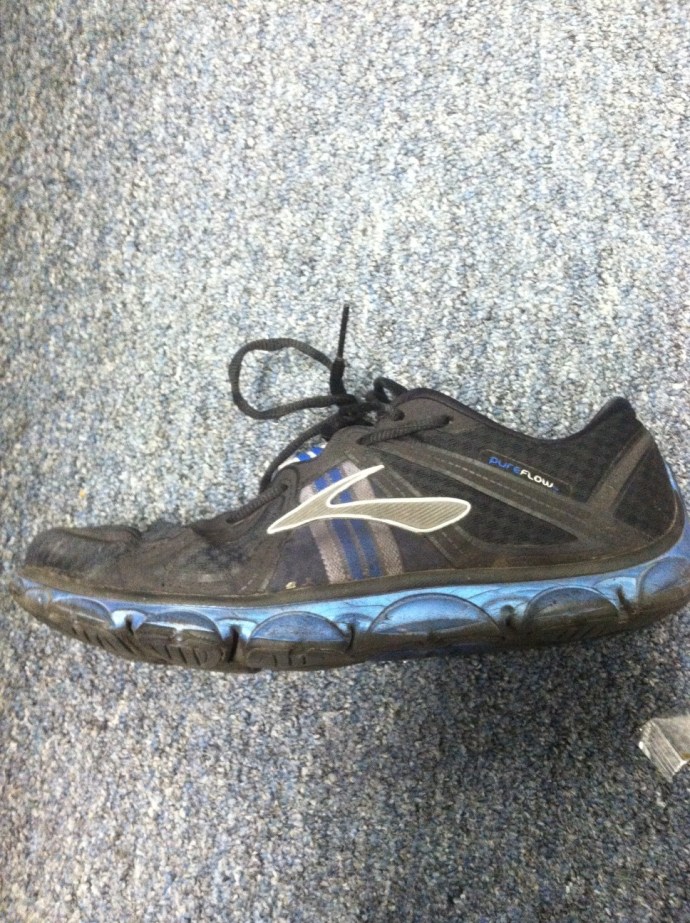
Why the hell am I talking about A single pair of running shoes?????

As a distance runner, we cycle through running shoes every 200-400 miles (a bit more if you are an efficient runner or they are an extremely good pair of shoes). Most of us have a minimum of 3 pair that we cycle through each week. So why is this particular pair so sentimental?

This, now highly worn, fairly dirty and extremely smelly pair, were my first pair of the Brooks PURE shoe line and are the Brooks Pure Flow. They are a very versatile shoe and can be worn for everyday training, long races and or short races such as a 5k.

I received this pair of shoes, as a gift from Final Kick Sport www.finalkicksports.com . These shoes were a gesture of support for Team Tim and our upcoming Boston Marathon.

So, that particular reason right there is reason alone to have such a strong feeling towards these shoes.

Because I was coming off of an Achilles injury, I needed a pair of lightweight, but well cushioned shoe to get me through the grueling distance of the marathon. From the moment I put these shoes on, I was in love.

These boys have seen a lot of miles and have shared in many of my greatest experiences thus far with my running career.

Aside from the untold amount of training “miles and smiles” with great friends, this pair of shoes saw Tim and I through our Boston Qualifying time at The Shamrock marathon in March, our first Boston Marathon in April and also mine and Chandler Doeblers’ first Marine Corp Marathon in October.

They were also my go to shoe for the Colonial 200 mile relay in September…A race that I shared along side many of my closest friends.

They have been a part of several race day PR’s (my own, as well as races where I paced a friend or my wife).

As much as I hate to officially retire these shoes, it is time to do so. They will now be reserved solely for casual walking, checking the mail and taking out the trash.

Though they have been replaced with a new pair of the Brooks Pure Flow, they will always hold a place in my heart and will always be remembered.

Rest In Peace boys!!

It’s a TRAINING plan, NOT just a running plan!!

Just as the title suggests, it’s a “training” plan and not just a running plan!! What I mean by this, is that, in order to be successful, over the long haul, you need to focus on the entire package and not just on the running alone.

Majority of runners, novice and experienced alike, tend to assume that just running tons and tons of miles will eventually turn them into the runner they want to be. They find some cookie cutter training plan or they try to mimic the Kenyan plans, the Ryan Hall or Kara Goucher plan, etc, etc.

What they fail to realize is that the aforementioned runners are not only extremely talented and gifted runners, but they are also very routine oriented and adhere to a strict TRAINING regime.

So, even though nobody reading this will likely ever be capable of a 2:04 marathon, no matter how great your training is, you can still follow similar training strategies to maximize YOUR greatest potential.

WHAT MAKES UP A TRAINING PLAN???

First off, you have to determine your area of interest and target “sport specific” training. Though some of you are tri-athletes, ball sport athletes, swimmers, etc…for the sake of confusion and because this is a running blog, I will keep everything running related.

  • RUNNING – this is fairly obvious, but not necessarily clear and understandable. To be good at running, there is no big secret, you HAVE to run. Where this gets murky is, HOW MUCH, HOW OFTEN, HOW FAST, etc. In the world of running, there are as many training philosophies and training principles as there are stars in the sky. What is the perfect one? That is an question the will never be answered, because there are just too many variables and too many skill levels and natural talents of runners. I will not go into any great detail on my views and theories (at least not in this blog post). However, I will say, that no matter what type of runner you are or what skill level you are, if you want to maximize your potential as a runner, you should be out there running at a minimum of 3 days per week.


  • NUTRITION – This should be another fairly obvious part of training, but not very well defined. The body is a machine (a very finely tuned one at that). In order to operate as efficiently as possible, the body needs to be fueled properly. Just as your car needs quality gasoline, so too does your body need quality nutrition in order to be able to go the distance. Again, I won’t go into great detail on all the various nutritional and diet ideas out there, but I will say this. Make your eating habits a lifestyle and not just some predetermined diet that last X amount of time. I myself follow a eating lifestyle of a ration of about 60/20/20. Meaning that I eat about 60% carbs, 20% proteins and 20% fats throughout the day. Also, I try to make sure that most of my food sources are natural and not “man made”. My thought process is this “If it didn’t come from the land, keep it out of your hand”.  I tend to eat mostly lean meats, lots of vegetables and fruits, occasional whole grains and rice and a good amount of nuts, nut butters. I try to minimize anything packaged and “man made”  and try to minimize the intake of gluten. Essentially, if it’s packaged and has ingredients I can’t pronounce, it stays away from my body. My one and only weakness and vice is BEER!! I have drastically cut down my consumption of this heavenly nectar, but I still must have a few per week!


  • X-TRAINING – Cross training refers to any type of physical training other than your specific sport (in this case, running). As a runner, there is much benefit to cross training. Because we are almost always moving in a forward motion, never side to side or laterally, we tend to have biomechanical imbalances and weaknesses, which if not addressed will usually lead to an injury of some degree and or hinder performance. In order to be a good runner and to minimize the wear and tear on the body, you need a good strong core. The core, just as it states in the name, is the center of all body function. When you see an elite runner finish a marathon, are they hunched over and or running as if they are sitting in a bucket? Not likely! The reason is because they have a strong core that allows the rest of their body to extend the time and distance before their muscles get too tired to respond to demands of a hard race effort. Again, there are many examples of X-training, but some examples include : Swimming, x-fit, hiking, aqua jogging, weight training, balance exercises, etc. Cross training can also be used as a means of recovery from a hard running workout. The different type of training will engage different muscle groups and will give your tired running muscles a well deserved break.


  • RECOVERY – This one is of utmost importance!! Anybody who has been running any significant amount of time, knows those runners who are slave to their Garmins or slave to always going hard, hard, hard. Just as the KEY runs are important to your running success, so too are the easy/recovery days. Recovery does not have to mean taking complete time off from training, however, it does mean you should at least try to have a day in between hard workouts. Without going to deep into the science of it all, the body tends to get into a very acidic state by doing too many hard workouts, too often. Aside from screwing up your pH levels, frequent hard workouts will also take their toll on joints, muscles and your immune system. Fatigue and overtraining from continuous hard workouts will often result in injury, decreased performance, severe fatigue, etc. No matter your skill level, do not be afraid to take a recovery jog that is substantially more relaxed than your typical training pace. Not only will the relaxed pace allow your body to unwind from hard workouts, it also helps promote blood flow to areas that need a little TLC. Another benefit in easing up on the pace a couple times a week in between hard workouts, is that it likely will allow you to run with other fellow runners of a different skill level, maybe allow you to run with your spouse or child, etc. If you are feeling overly tired and or possibly experiencing the early signs of over training, go for a nice relaxed easy run and you just might feel better! Recovery also consists of nutritional habits and other practices to keep you running strong and ready for the next workout.

Although it is also part of the nutrition category, post-workout nutrition is considered recovery as well. Whereas most of our nutrition is designed to help us prepare for a workout/race and to help us with performing at our best, the post workout nutrition is what allows our bodies to recover from the hard training and allows us to come back strong for the next workout. After all workouts, particularly the hard efforts, get in the practice of having a recovery drink. Some perfect choices for this are BOOST, ENSURE, ORGAIN, SLIM FAST, MUSCLE MILK, etc, etc. All of these liquid type drinks have optimal ratios of your carbs, proteins and fats to maximize immediate recovery. Try to consume one of these within the first 10-20 minutes post workout.

Other means of recovery include hot/cold therapy, compression therapy, stretching, etc.

  • REST – Although this sounds like a repeat of the RECOVERY step, it is actually quite separate and unique. Whereas “recovery” can take on many possible meanings, REST is REST! It means that this is the time that your body takes in and absorbs all those hard workouts, where it adapts to the training stresses and where it regenerates itself in preparation of the upcoming training. Here, in the rest cycle, our bodies are recuperating. Though rest is usually thought of as sleep, it can also come in the form of OFF days (days of no running, or other x-training),  easy walking or just sitting pool side with a cold adult beverage 😉


  • MAINTENANCE – This category is a bit of rest, recovery and x-training rolled into one. Often, runners wait until they are injured before getting routine maintenance done. This would be like taking your car in for an oil change after you already blew the engine (doesn’t make sense, does it?).


Maintenance can include but is not limited to, stretching, massage (self or professional), hot/cold therapy (ice baths, Epsom salt baths, etc), acupuncture, ART (Active Release Technique), chiropractic, yoga, etc, etc.

Essentially, this area is focused on taking care of the body from the physical sense and taking counter measures to ensure that the body is able to continuing performing at it’s highest and most efficient levels. If you have never done any of the above types of maintenance, PLEASE look into them..they can save your running career and your sanity by preventing injury.

Okay, so there are some of the key components to a successful training plan. Though no two training plans are ever going to be exactly alike, if you take the time to focus equally on each of the above mentioned topics, I will guarantee that you will not only be the best runner you can be, but you will most likely enjoy every step of it. Remember, running should not be painful, it should not feel like a job and it should not be something that you loathe. Running is supposed to be our escape from all the stress and hardships that life often throws our way.

Though this blog post was intended to touch on the high level areas of a training plan, there is much more detailed material available out there. If you have any specific questions on any certain area, please feel free to ask me. I will provide any and all knowledge within my realm of understanding. If I don’t know the answer, I know many professionals who can provide those answers and will be happy to pass along their information for you to consult.

HAPPY TRAINING!!

A Proud Husband/Coach!!!

So, most of you who know me, know that I am a runner!! I live, breath and sleep ANY and ALL things running. I will talk about it, schedule my day, weekly life and vacations around it….I will spend hours and hours reading about it, watching it…..blah, blah, blah..you get the point!!

What few of you know is, my wife’s journey and steady progression with becoming a runner.

Crystle Santos (Welch), my wife, was born with club feet http://en.wikipedia.org/wiki/Club_foot . To give you a general description, she was born with her feet completely inverted. Thus, her feet were turned 180 degrees from their natural position.

Her first couple years of life involved having  surgeries and her feet in casts. She was told that sports, particularly anything that involved running, was not advisable. So, with the news from her doctors, she participated in gymnastics for a few years and a bit of cheerleading, but otherwise, none of your traditional sports (those involving running).

Now, fast forward 20+ years to 2010.

Crystle started her running endeavors, solely for me…she had run a few times before, here and there, but mainly just for fitness and weight management….she never enjoyed running and never saw much excitement in it…..but, being the supportive girlfriend (at the time) she was, she decided to start gradually taking up the sport of running.

I joined the world’s greatest running group http://www.meetup.com/HamptonRoadsRunners in June 2010 and started running several times a week with them, mostly at Mt. Trashmore.

Crystle would accompany me to Trashmore, but would usually only walk or do some light running with another acquaintance , who was not a part of the group.

Her original concerns were that “she wasn’t fast enough” for the group, or that “she didn’t really enjoy running THAT much”…

After going out on some social excursions with members of the running group, she was finally peer pressured and relented into coming to some of the meetups and being a part of the runs.

From the start, she put in some effort, but was never “in love” with it. But, with the help from some of the girls in the group and with consistency, she started seeing improvements and this started to slowly change her mind a bit.

Her first actual race, was a Jingle Bell Run in December of 2010…I had done a long run that morning and decided to just be the photographer (a position of responsibility that is typically hers)….So, our mutual friend, William Tallent decided to “pace” her……he took her out at a pace well within her abilities, but, things didn’t quite go so well that day.

Within under 30 minutes from the race start and against my advice, she decided she would eat a chicken wrap from Chik-fil-A…..So, 29 or so minutes later, she came around the corner and was within 100 meters of the finish line…I was cheering and yelling and taking pictures, when all of a sudden, I realize things weren’t good…she approached me, stopped, puked on my shoe and professed her desire to quit and walk off the course…After a minute or two of convincing, I talked her into at least jogging it in to the finish..which she did in 32:34 (10:29 pace).

Back then, she would never even think of caller herself a “real runner”. Her biggest hopes were that someday, for a race or training run, she could hold a 9:00 pace…To her and at the time, that seemed like all she would ever be capable of…Man, was she wrong!!

After completing a couple 5k’s and a 10k, she finally committed to running her first half marathon. She decided to do the Rock n Roll 2011 half since that is one that our running group and Team Hoyt does every year.

We kept her expectations within reason and she ran a very respectable 2:17 (10:30 pace…NOTE, this pace for 13.1 miles was the same as her first 5k, less than a year prior).

Even though her first half was somewhat of a challenge, she had fun and enjoyed it and wanted to put in better training for another one. So, I started her on a training plan and started to coach her so that she could continue to improve, but at a rate that wouldn’t kill her. I wanted her to do well, but not at the risk of burnout or injury.

Because a large majority of our Hampton Roads Runners group was targeting the Outer Banks for the marathon/half marathon, Crystle decided she too would like to do the half there as well.

Since I was pacing a friend, Gerald Currie, for the full marathon, another friend and fellow HRR member, Fitz, decided to pace Crystle for her half. He kept her at a comfortable and steady pace the entire time. She PR’d by over 8 minutes, running a 2:09 (9:53). So within just two months from the Rock n Roll, she already took off another huge chunk of time.

Now, after having run two half marathons within two months, she was feeling more confident with her training and was enjoying her gradual improvements…But, she still refused to believe she was a runner…..now she was saying, “If only I could get down to sub 9:00 pace”..LOL!

Toward the end of 2011, the HRR group started getting several new members..many of which become perfect training partners for Crystle. Several of these runners were experienced runners with many races under their belt and they would become her frequent training partners for the winter.

During this time, I had Crystle on a 3 day per week running routine. Her runs consisted of a “tempo interval workout” a “tempo” and a “long run”. Enough to continue improvement, but not so much that she was tired or beat up all the time. This would allow her to see gains, feel confident, but not succumb to the typical workload of most traditional training plans.

As she continued improving, her and several of her new training partners begin throwing around the idea of going sub 2:00 hours in their next half marathon.

So, as winter passed and spring turned to summer, Crystle continued to improve on her times, running several 5k’s to help get her comfortable with harder paces. Aside from just running, in the spring, she started training with Jamie Brennan, who was coaching and advising her with swimming and cross-training.

In addition to her 3 runs per week, Crystle would swim 2-3 times per week and would also hit the gym 3-4 times per week. During this time, she continued to see running success, without adding any additional mileage or intensity. The mix of cross-training, running and swimming seemed to be the perfect combination for her. She was dropping weight/body fat and was starting to sculpt some serious muscle tone…I was actually getting jealous!! LOL!

Because her and I had a wedding coming up in August, Crystle decided to not target any big race until after the wedding. So, since the next closest half marathon after our wedding was Crawlin’ Crab in October, she decided to target that one.

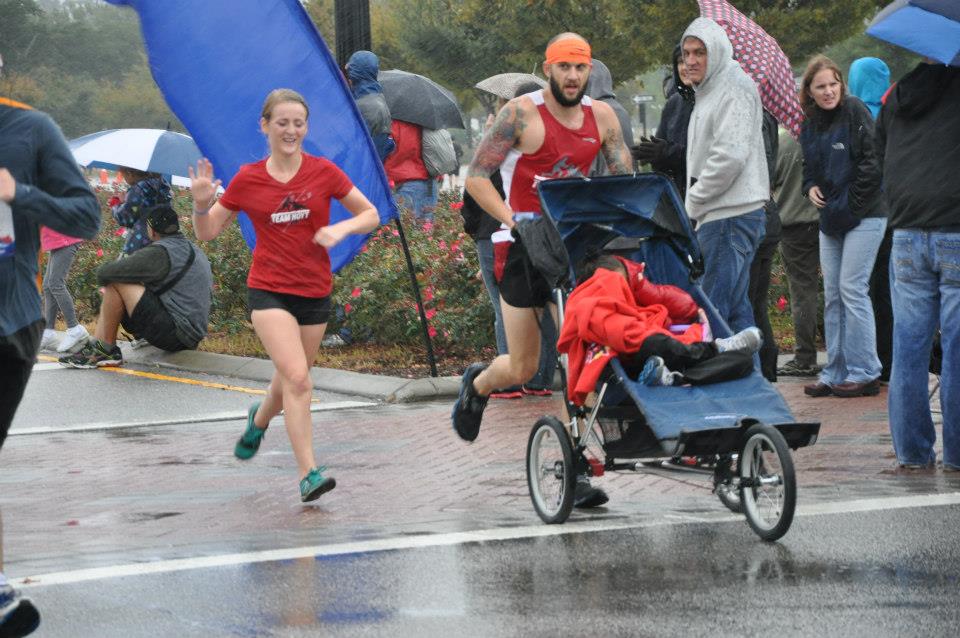
Her goal was sub 2:00 hours. Based on all of her training runs leading up to the race, I KNEW she could go sub 2 and then some. But, to make certain that she obtained her goal, I decided I would pace her for the race. Because I was running the race with Team Hoyt, I figured this would be perfect. She could run along beside me, I would push my rider and could also ensure Crystle maintained pace, fueled and hydrated properly and had someone there to break up the boredom.

For her to break 2 hours, she needed to maintain at least a 9:09 per mile pace. But, because I knew her capabilities and was she was fitness wise, I decided to take her out at 8:50 pace to build a bit of a comfort zone for her goal time.

I made her leave behind her Garmin and I would worry about the pace. Her only job was to stay right on my shoulder.

She ran the absolute perfect race…All splits were right on point and she ran completely comfortable and relaxed the entire time. The last 2 miles were rainy and nasty and she still pushed on…and we finished together, running a 1:55:56…a whole 4+ minutes below her original goal….She had the biggest smile on her face and I couldn’t have been happier for her.

No matter the goals she sets or the paces she deems as “unachievable”, she always meets the challenge. Every race and every training run, she gains more and more self confidence and realizes “Hey, maybe I am a runner after all”. For instance, just lastnight, I had her doing 4×6 minute repeats at 5k-ish pace. She ran all 4 of her repeats in the range of 7:48-7:56 and even managed to PR her 5k, in training, without even trying.

Aside from not only becoming a good runner, she has also become a wonderful training partner for me and a big pillar of support to new members that join our group. Now, because her regular training paces have dropped so much, her and I are able to get in 2-3 runs together per week. I normally get to pace her for her tougher workouts and help pull her along (which I really enjoy being able to do for her).

In the short span of two years, she has become her own person through running. She has improved in so many areas and running has even helped her with her foot issues. In the past, she could barely walk in the mornings after being on her feet all day with work or school. Now, and for reasons not completely known, she no longer wakes up with the pain and soreness of years past. The running has helped cure the problem.

She has also helped to inspire her family. Because of her running, her father has recently taken up running and ran his first half marathon last month. He narrowly missed breaking 2 hours and now they are talking of running their next race together so that he can break that 2 hour mark.

Her next big race will be the Shamrock half marathon in March. She has thrown out a number to shoot for..I won’t mention it, because I don’t like to jinx things. But, as her coach, husband and biggest supporter, I know without a doubt she will hit her mark!!!

Stay Tuned!!

Colonial 200 Relay

This slideshow requires JavaScript.

So what do a group of runners do over a 24 hour period, just for fun? They decide to cram themselves into a van and run a combined distance of 206.8 miles!!

Yes, that’s what myself and many of my closest friends did this weekend. The Colonial 200 relay is a distance running event that consists of 206.8 miles, comprised of 36 varying distance “legs”. The premise is that a number of runners 1-12, pair up to make a relay team, then divide the legs accordingly, run the distances back to back with no rest and take a total “running clock” time from the start to finish, which is point to point.

This particular relay started in Charlottsville, VA and finished in Williamsburg, VA.

The idea of doing this relay started as just casual running talk last winter. Several of us in the running group http://www.meetup.com/HamptonRoadsRunners/ were talking about doing one of the Ragnar style relays and many of us had decided it would be a great idea and that we would “look into it”.  After a few days of surfing the running forums, we found one that would be perfect. It would be a 200 mile relay that started only 3 hours away from the 757 (Hampton Roads, Virginia).

At the time, we only had one small issue. Because there were so many of our runners who “wanted” to do it at the time, we needed to decide on whether we wanted to do a couple of 6 person teams (Ultra), or put together a 12 person team (Full). Tentatively, from the start, we had decided that we would do a 2 x 6 person team that would be comprised of runners of equal ability, so that we could have a good little inter-group competition.

Now, fast forward to the summer of 2012 and we are still scrambling to put together a team. Because of several running injuries, vacations, weddings, etc, our 2×6 person team idea was looking like it might have fizzled down to having trouble to even find a single 6 person team.

After several last minute decisions, we finally ended up finding 10 crazy runners who would literally sign up last minute (race started yesterday, Friday 9/28 and we signed up on Monday, 9/24) and run the relay.

Based on running experience, current training and upcoming races, we divided the amount of distance that each individual would run, accordingly. A couple of us on this team had experience with this format of racing (a few of us had run the 200 mile Green Mountain Relay, last year).

For this particular race, those of us runners from the 757 would represent several teams. The Hampton Roads Runners were putting together one 12 mixed team (male/female) and also one 10 person (all male) team. A few more of our friends and training partners would be putting together another 6 person ultra team.

So, we had at least 4 teams (that I know of) representing the 757. There were the 2B5D team (Tommy Neeson, Ryan Carroll, Joel Bell, Dai Roberts, Renee High and Drew Midland), Team HRR Procrastinators and a Diva (my team, which consisted of myself, Ryan Foster, Aric Martinez, Rob Hunter, Thomas Hicks, Rich Montgomery, Derek Bush, Kevin Kemp, Chad Shroy, Mike Deering) and also Team HRR Full (Mike Wolfe, Mary Wagner, Gerald Currie, Terry Koob, Jillian Little, Marc and Andrea Leber (mother/son), Becky Perron, Sarah Guathier, Lauren Sheppard, Wanda Renner, Dena Goble) and the Sea Slugs (Brian Cobb and his teammates, sorry I don’t know the other members names).

Now, there are probably a few additional details to understand, but the gyst of a running relay goes like this; Runner A runs X distance and passes off to runner B who runs X distance (repeat as often and as many times necessary to cover the 200 miles and 36 legs).

On paper, 200 miles, split up between several runners (usually between 6-12) does not look too daunting (for this race, the shortest leg was 2.1 miles and the longest was 10.45). However, when you cram these 200 miles into the time frame of 36 hours or less, plus inadequate sleep, improper nutrition, cramped living conditions (a van) and multiply personalities….things can get rather interesting, to say the least.

The race started at 6am Friday morning and would continue until 6pm Saturday evening (36 hours). Teams would start based on projected race pace, therefore, the teams would start their race between the hours of 6am-12:30pm.

As a runner, you could run your entire life, complete hundreds of races and have a multitude of individual running accolades and acheivements…but NOTHING compares to running a distance relay. Typically, when a runner enters a race, he/she is running either against his/her fellow runner or they are running against the clock for a personal time goal. However, when you are running a relay, you not only rely on your teammates to uphold their end of the bargain, but you also FORCE yourself to uphold your end of the bargain. You all depend on one another for support. You build off of one another’s stengths and you unite as a TEAM. If one runner fails, or one runner fails to complete a leg, the entire team fails…so it is no longer about self will and self determination…collectively, you all have to merge together to create one big badass running machine!!

In a relay, because there is such great distance to cover and so much of a time span to do it in, there is not the typical “race experience”. You will not be surrounded by tens, hundreds, thousands of other runners pulling you along…you will instead be surrounded by the your environment and that is pretty much it. You are out there alone, running by yourself for miles and miles..but, at the same time, you know that you have to keep pushing yourself as hard as you can because the team is depending on you and your efforts. Letting yourself down is one thing, but letting down your team is something entirely different.

In this particular race, we had a nice little friendly competition going. Because many of us in the 757 running community run and train together, we become friends (more like family), despite that we might run for different running clubs, teams, etc. Amongst a couple teams competing against one another, we had runners, several of which were on the same team, representing several various running affiliations (Hampton Roads Runners, Final Kick Sports, Running ETC, Dai Roberts Group, Team Hoyt and Tidewater Striders).

For this day, we would set aside any “affiliation” and come together on our respective teams, competing against one another in the name of competition and good fun.

Amongst two teams in particular (Team 2B5D and HRR Procrastinators and a Diva), there was some very fun competition brewing. These two teams were comprised of 16 total runners who run, train, laugh and socialize with one another on a daily/weekly basis. Before the race even started, there was a good amount of friendly “trash talking” about who was the best team and who would win and also to what lengths we would go to for a win (there was talk of kidnapping, espionage and malicious acts..LOL!).

Before I disclose the final outcome of the race, I would like to point out that it was never FAIR to begin with 😉

Team 2B5D was comprised of 6 runners with multitudes of accolades and accomplishments…to name a few, they had 6 sub 3 hour marathoners, a two-time Olympic Trials qualifier, a Kona Ironman qualifier, a European Master’s 10k champion, a 1:07 half marathoner and a guy who ran the entire east coast for charity. So YES, they were STACKED!! Disclaimer: The more awesome I make them look, the less likely anyone will notice that my team got 2nd place and were beaten by them..LOL!

So, how did the race turnout? Well, to summarize, we spent 20+ hours of running, riding, laughing, joking and having an unbelieveably awesome time!! I could go into greater detail about how the race went “leg by leg”..but, for those details, you would just need to have been there..some things cannot be described well enough in words. These relays provide and experience like no other…several runners come together for a day to have fun, find themselves, find one another and connect on an entirely different level…you could KNOW someone for years..but you REALLY get to know them when you have been crammed into a van with them all day and have grown tired and irratible, once they have become severly sleep deprived or just down right delusional…LOL!

Now for those results!!

Team 2B5D (2 Boobs and 5 Dudes….team was comprised of one female and five males) ended up taking the top honors. First place overall, new course record and overall finishing time of 22 hours (6:26 per mile pace). Great job guys/gal!!!

Team HRR Procrastinators and a Diva – 2nd place overall, also broke the former course record and overall finishing time of 23:35 (6:50 pace).

So, are you now interested in running a distance relay? My advice is this…DO IT!! You are certain to have a blast..it will be tough at times and you will no doubt experience lots of discomforts and not so great moments..but you will also have tons of fun, unlimited laughs, unknown adventures and a chance for one amazing bonding experience. You will discover things about not only your teammates, but also about yourself..you will learn that you CAN go harder than you ever believed possible when it’s for the greater of the TEAM.

Who Needs GU??

In my ongoing efforts to incorporate a more natural diet into my life, I continue to find new ways to make healthy (and much cheaper) alternatives to the processed energy drinks, gels that are most commonly used in the world of endurance sports.

Any individual who has ran, biked, swam (or all three) for any long periodes of time (60 minutes or more), know exactly what I am talking about when I use the term ENERGY GELS. They are often referred to as GU’s (which is just a brand name of a particular gel), Gels, shots, etc.

These days, there are countless brands, flavors, consistencies and types of “energy gels”. The claim being that these said gels will provide the athlete with energy, in the form of some carbohydrate sugar (fructose, glucose, sucrose, etc, etc). I won’t go into great detail on “how” or “why” or “if” these gels work (I did include a link below for those interested though).

Essentially, it is a proven and well known fact that as an athlete exercises (particularly for long periods of time), they burn through their energy sources (fats, carbohydrates, proteins). Depending on the intensity of exercise, one will be either more fat or more carbohydrates. Studies show that athlets can teach their bodies to burn fat more effeciently, but for most types of excersise, carbohydrates are the primary energy source.

Another concern during exercise is that an athlete will lose their electrolyte stores (potassium, magnesium, sodium, etc).

This is where energy gels and sports drinks come into play. As an athlete performs his/her sport, they begin to lose their fuel sources and their electrolytes (among other vitamins and minerals). After a certain amount of time (different for everyone), the athlete’s performance will begin to degrade if they do not replace what is lost through the demands of sport.

In endurance jargon, we call this “hitting the wall”. This is where an athlete has depleted their glycogen, depleted their electrolytes and or both. This typically can result in severe cramping, total exhaustion, dizziness and or sometimes total loss of control of the body.

So how can one prevent hitting the wall? Well, there is no definitive answer to this question really. Some runners (whether through trial and error, genetics or learned technique) can burn fat as a fuel more efficently than they do carbohydrates (fat stores are much more abundant than glycogen stores).

If one can prevent, or at least minimize the amount of fuel that is lost, the greater the chances are they can maintain performance over the length of time they are hoping to achieve.

So, what about those energy gels? Now I will not sit here and tell you that I know how effective energy gels are or how well they work or don’t work for each individual. I will however tell you that I have had some fairly decent success in using them (be it mental or physical). Upon taking a gel during a race (marathon), I have noticed a brief spike (usually 15-30 minutes) in energy levels. With that said, for the past two marathons I have completed (Boston and Shamrock), I did not use any store bought, processed gels or sports drinks. For sometime now, I have been tinkering with my own sports drinks and energy gels. For the most part, I have seen the same results by using both.

So why not just use what is convenient (store bought)? For me, the answer is two fold. ONE, is of a health concern. Majority of store bought gels (with a few exceptions) have a gelling agent in them that is not easily broken down by the body (it also slows the absorbption rate of the sugars within the gels). There is also many other “artifical flavors” added to these gels. Also, these gels typically have very very small amounts of your essential electrolytes (potassium, magnesium, sodium, calcium, etc). For a “salty sweater” or heavy sweater like myself, the gels are not likely to replenish the amount of electrolytes that are lost through the sweating process (in the past, this has caused severed cramps and fatigue for me). Here is a link that touches a little more on electrolyte loss for a “salty sweater”. http://www.training-conditioning.com/2007/08/salt_in_their_sweat.html

TWO, energy gels are rather expensive. Even if you get them on discount, they typically run from $1.50 and up. So, on a long training run, or during a marathon, the typical runner might take a gel every 15-45 minutes. At that consumption rate, you are looking at between 3-10 gels depending on perceived needs. That translates to a minimum of about $4.50-$15.00 per training run or race.

So, as I have continued to experiment with various formulas and recipes, I feel that this formula is a pretty good base to work with and from.

I have chosen the three primary ingriedents (chia seeds, dried apricot, dried mango) for several reasons.

1.) These three ingriedients contain large amounts of natural electrolytes. Dried apricots per gram contain more potassium than any other fruit. Chia seeds are loaded with good fats, calcium and many other vitamins and minerals http://nutritiondata.self.com/facts/nut-and-seed-products/3061/2.

2.) These three ingreidients absorb liquid very well and once they have absorbed the liquid (water or cocunut juice in this case), this adds to the hydration factor. This also helps to create a more “gel like” consistency.

3.) The taste! These three ingredients seem to provide a very nice taste combination (sweet and tarty).

Okay, so what’s with the OTHER ingridients? Well, these are other dry forms of electrolytes. Electryolytes can be found in many natural and or processed products. All of these ingridients are OPTIONAL. Based on your diet and or possible deficiencies in the various electrolytes, you can add and or subtract to ensure you are consuming sufficient amounts of each.

  • The MAGNESIUM PLUS blend contains 3/4 of your DV% of magnesium per scoop. This blend is high in Vitamin C, Vitamin B6, B12 and Zinc.
  • The PALM ISLAND black volcanic salt is used for added sodium supplementation. There is also many other minerals contained within the salt. You can also substitute Sodium Bicarbonate (plain old baking soda) as an alternative sodium source (also another aide in balancing PH levels in the blood).
  • CREAM OF TARTAR – Also known as Tartaric Acid (very high in potassium and also helps to balance PH levels in the blood).
  • Taurine – Just read up on this ingridient, there is far too much information for me to go into great detail here.

Okay, so now on with the recipe and the process of creation!

FIRST – Take the dried mango (4-6 slices), apricots (6-8 pieces) and chia seeds (2-4 teaspoons). Add all three ingridents to 8 ounces of water or coconut juice. Let this sit for 30-45 minutes, until the mango, apricot and chia have started to absorb the liquid.

SECOND – Throw all above ingridients into a blender and puree until desired consistency. Add either more water or more mango, apricot, chia until you have reached the desired consistency.

THIRD (optional) – Add 1/8 teaspoon of sea salt, 1 scoop of Magnesuim Plus, 1 teaspoon cream of tartar, 2000mg of Taurine and blend thoroughly into mix.

Once you have reached the desired consitency of mixture, pour into your running flask or handheld bottle. The above recipe yields about 16 ounces of gel.

Keep in mind, this is just a base formula to go by. You can change up the frutis to include figs, cherries, cranberries, etc. You could also add your own sources of caffeine (powdered form, ground coffee, tea extracts, dark chocalate, etc.). If you would prefer more sugars/carbs, you could add honey, agave nectar, cane sugar, brown rice syrup, etc. The list of ingredients are limitless..Just play around and expermine until you find what is best for you.

Hope you enjoy! Below are some additional links with more information on some of ingridients and other topics discussed in this post.

http://healthpsych.psy.vanderbilt.edu/SportsGels.htm

http://www.healthaliciousness.com/articles/high-potassium-fruits.php

http://greensplus.com/index.php/cPath/84_86

Pure Power Energy Bars

In my long going efforts to perfect, not only for me, but also for my fellow training partners and endurance athletes, I am continually working on my own homeade energy drinks, gels and other energy sustaining treats.

Normally, I do not have an actual recipe. I have been cooking long enough, that I pretty much know how to pair various ingredients in their respective quantities and just go one ingredient at a time until I believe it is “just right”. But, so that others can re-create these energy bites, I have come up with a recipe.

DISCLAIMER: Please understand that substitutions can and should be made based upon tastes, allergies, ingredients available, etc.

So lets get started! Oh, I should also add that the name Pure Power is something I got from Kris Lawrence.http://kris-lawrence.com/  It is a little inside joke between her and her former coach and I just liked the name and figured it was perfect for my energy bites….hope you don’t mind Kris 😉

STEP # 1

Acquire the ingredients below (make subsitutions as necessary). BANANA NOT PICTURED!!

The above ingredients are mostly the WET and or BINDING items.

Ingredient List

1/3 Cup Flax Seed (ground meal)

1/3 Cup chia seeds

2 tbsp Peanut Butter

1/3 cup Almond Meal

2/3 cup applesauce

2 tbsp greek yogurt

1 cup Trader Joe’s Golden Berry Blend (dried raisins, cranberries, blueberries, cherries)

1/3 cup shelled sunflower seeds

3 teaspoon vanilla extract

1 1/2 teaspoon ground cinnamon

2 teaspoon Trader Joes brand Sugar/Coffee Bean/Chocalate grinder mix

1/3 cup blue agave syrup

1 cup dark chocalate chips

1/3 cup wildflower honey

2 cup multigrain oats

1 mashed banana

1 medium cooked and mashed sweet potato

1 egg

1/3 cup coconut milk.

Step # 2

Peel the sweet potato, cut into small pieces and boil in hot water for approximately 20 minutes, or until soft. Once the potato is soft, remove from heat, strain and mash.

Step # 3

In a large mixing bowl, add and mix all of the above ingredients. Mix until all ingredients are combined and the batter is the consistency of peanut butter. Then, pour batter into baking dish. NOTE: I use a muffin pan and the above recipe will yeild 12 large muffins. However, you could use a cookie sheet and scoop the batter into cookies, bake in a cake pan and then cut into various sized bars, or you could also use a bread pan (if you use a bread pan, the cooking time may be different due to how deep the batter is. In the muffin pans, the batter is 1 1/2 to 2 inches thick).

Step # 4

Place into oven and bake at 250 degrees for approximately 25 minutes (check every few minutes, since every oven cooks differently). When you can stick a toothpick in the middle and pull it out without any batter on it, THEY ARE DONE!

ENJOY!!!

The Spartan Salad

Here is something that I HAD to share! Yesterday, Crystle made this amazing, ALL INCLUSIVE salad, that turned out to be quite possibly the most amazing thing ever!! It is not only delicious, it pretty much contains about every daily nutrient you could ask for. You could pretty much alter this recipe a million different ways and use a million variations of the ingredients to change it up and mix it up to keep the flavors coming.

As most of those who read this blog are healthy athletes, this is in my opinion, the PERFECT recipe for fueling up during the day. This here salad will get you through and fuel you up for the most intense workout and it can be enjoyed any time of day as a before or after workout snack/meal.

Here is a the EXACT salad that Crystle made yesterday and I will also add a few other ingredients that we will be adding to future variations.

Keep in mind, there is not necessarily any exact measurements for the ingredients. Measurements and quantity will be based on how much you are wanting to prepare and how much of the ingredients you have in your kitchen.

2 cups chick peas (you could subsitute chick peas with kidney, black or other type of bean, legume)

4 cups of fresh leaf spinach (could use other leafy greens here…kale, watercrest, etc)

2 cups endamame shelled (Trader Joes brand)

1/2 red onion (diced)

1 tomato cut into small triangle wedges

1 cup dried cranberries

1/2 cup almond slices

1/2 cucumber cut into small chunks

1/2 cup feta cheese (try not to substitute cheese type here..the flavor of feta works well in this salad)

1 cup brocolli (raw and cut into small florettes)

2 cups cooked couscous (you could subsitute regular couscous with Isreali couscous, Quinoa, Bulgur Wheat or other)

1 cup diced bell peppers (try to use multiple color, orange, yellow, red, green)

2 hard boiled eggs (diced up)

Baked Chicken breast (could substitute with turkey burger, steamed shrimp or other lean meat of your choice…or no meat for you vegetarians)

THAT’S IT!!! That is the recipe…Now, for the other yummy variations and optional ingredients:

Fresh berries (strawberries, blue berries, raspberries, etc.)

Dried fruits (apricot, mango, apples, etc)

Fresh fruits (apple, mango, avocado etc)

Nuts (sunflower seeds, pumpkin seeds, cashews, pecans, walnuts, etc)

Grains, noodles, pastas (variations of rices, variations of noodles and pasta..just about anything could be used here..get creative).

Olives

Other Cheeses

Oils (olive, grapeseed, avocado, etc)

Salts (sea salts, volcanic salts, etc)

Pepper and spices (paprika, black pepper, crushed red paper, etc)..

Okay, we have provided a base to get started with and also some other ideas for variations thereof! Now go out and get the ingredients and get started on your own unique version…Fuel right, perform right!!!